Rugby rules may seem complex at first, but make sense once you understand the logic.
Ad
If you’ve felt lost watching a match, relax, it’s normal once you understand rugby rules, everything starts to make sense.
And the best part? It’s not as complicated as it looks when explained the right way.
👉 Here, you will understand in a simple, practical, and straightforward way how rugby really works and what makes it so unique.

What Rugby Rules are and How the Game Works
Rugby rules revolve around a very simple objective: score more points than your opponent.
But the way this happens is what makes the game so unique and interesting to watch.
Unlike many other sports, in rugby the ball can only be passed backward using the hands.
This means that advancing across the field usually happens by running with the ball or using strategic kicks to gain territory.
Another important detail is that physical contact is part of the game.
Tackles, rucks, and scrums are fundamental elements and are constantly present during a match.
This makes rugby a sport that combines strength, strategy, and positioning all the time.
It’s not just about running… it’s about thinking while you play and reacting quickly to every situation.
How Points are Scored in Rugby
Within rugby rules, there are four main ways to score, and understanding them already puts you ahead of most beginners.
Each type of scoring has its own value and strategic importance within the game.
Here is how it works:
- Try → 5 points
- Conversion → 2 points
- Penalty → 3 points
- Drop goal → 3 points
These different scoring methods make rugby a very dynamic and unpredictable game, where multiple possibilities can happen at the same time.
Some plays require physical strength and forward movement, while others depend on precision, strategy, and game awareness.

Try: The Main way to Score Points
The try is the most important play within the rugby rules and represents the main offensive objective of the game.
It is worth 5 points and is considered the most valuable scoring action during a match.
A try happens when a player manages to carry the ball into the opponent’s area and place it on the ground with control.
This area is called the in goal, and it is where the most decisive moments of the game take place.
At first glance, it may seem simple, but in reality, it requires a lot of team effort and strategic coordination.
Players must advance across the field, overcome the opponent’s defense, and maintain full control of the ball under pressure.
It’s a play that combines strength, strategy, and teamwork at the highest level.
Conversion: The Kick after a Try
After scoring a try, the team has the opportunity to perform a conversion.
This play is worth 2 points and works as a bonus for successfully completing the previous action.
The player must kick the ball and make it pass between the goalposts and above the crossbar.
An important detail within the rugby rules is that the kick must be taken in line with where the try was scored.
This means that:
- Central tries → easier conversions
- Wide angle tries → more difficult conversions
This is where the player’s precision and technique become crucial.
Even though it may seem like a simple kick, it often requires focus and skill under pressure.
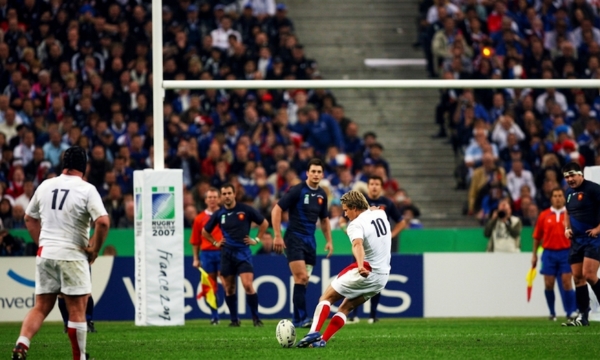
Penalty: When a Foul turns Into Points
A penalty occurs when the opposing team commits an infraction under the rugby rules.
In this situation, the team awarded the penalty can choose to attempt a kick at goal as a strategic decision.
If successful, they earn 3 important points, which can often decide the outcome of the match.
This kick is taken with the ball stationary, directly from the location of the foul.
It requires a high level of precision, concentration, and control.
The penalty is strategic because it lets teams score without reaching the try zone, taking advantage of opponent mistakes.
It is the classic way to capitalize on opponent errors and gain points efficiently.
Drop Goal: Scoring during Open Play
The drop goal is one of the most interesting plays in rugby, worth 3 points, but executed in a completely different way.
The player drops the ball and kicks it after the bounce, all while the game continues in motion.
Yes, the match does not stop, it happens during active play.
For the score to count, the ball must pass between the goalposts and above the crossbar.
The drop goal is often used in strategic moments, especially when advancing toward a try is difficult.
It is a play that requires quick decision making and strong game awareness.

Difference between Scoring Types in Rugby
Each type of scoring within the rugby rules has a specific role in the game.
To make it clearer, take a look at this simplified overview:
| Type of scoring | Points | Function in the game |
|---|---|---|
| Try | 5 | Main way to score points |
| Conversion | 2 | Bonus after a try |
| Penalty | 3 | Takes advantage of opponent fouls |
| Drop goal | 3 | Strategic scoring during play |
The try represents dominance, control of the field, and superiority over the opponent.
Kicks show precision and intelligence, often deciding matches in key moments.
This combination of physical play and strategic thinking is what makes rugby so unique.
Tips to Understand Rugby Rules Faster
If you are just starting, trying to understand all the rugby rules at once can feel confusing.
But there is a simpler way to learn without feeling overwhelmed.
Start with the basics:
- Understand the try (it is the most important play)
- Observe how teams move forward on the field
- Pay attention to kicks (conversion and penalty)
- Watch how ball contests happen
Then, little by little, you will begin to understand the more complex aspects of the game.
You don’t need to learn everything at once, progress comes naturally.
Another powerful tip is to watch matches focusing only on scoring.
This already gives you a much clearer understanding of how everything works in practice.
Over time, you start to recognize patterns, strategies, and movements more easily.